Recent News
More News >
New School at IS&T Presents 'Enormous Opportunities'
September 17, 2010
by Nick Schniker
The new School of Interdisciplinary Informatics firmly places the College of Information Science & Technology (IS&T) "on the leading edge of technology and education," said Nebraska Lt. Gov. Rick Sheehy.
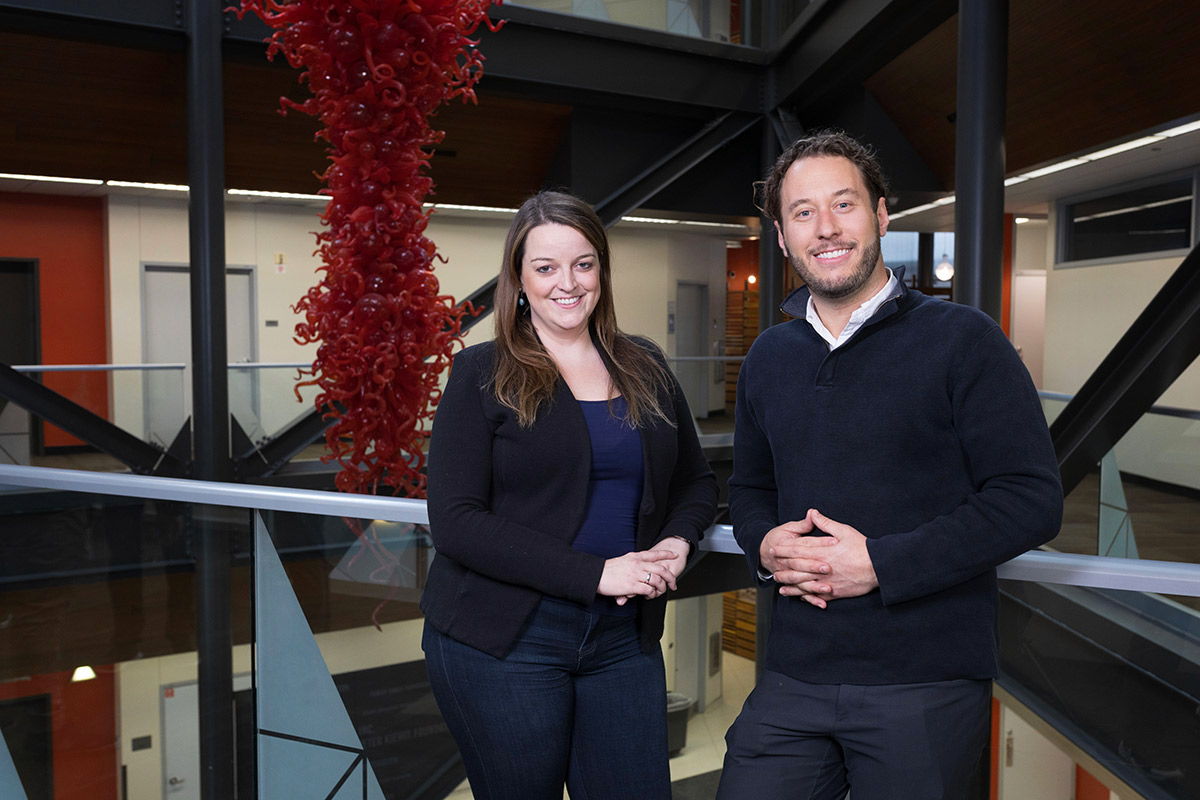
Lt. Gov. Rick Sheehy talks about the new School of Interdisciplinary Informatics.
In remarks at the opening ceremony Sept. 16, Sheehy noted the school's potential for drawing new business and students to the state. "The School of Interdisciplinary Informatics will greatly enhance our ability to attract and retain the best and the brightest," Sheehy said.
UNO Chancellor John Christensen lauded IS&T Dean Dr. Hesham Ali and Dr. Ann Fruhling, associate professor and the school's founding director, for their "wisdom, vision and extraordinary effort."
As technology continues to permeate society, Dr. Christensen said, "This school is coming on line at the right time, and certainly at the right place."
He also noted the "enormous opportunities for research and external funding" the school creates.
Dubbed Si2 for short, the school is the home of undergraduate and graduate degrees in bioinformatics, information assurance and the new bachelor's degree in Information Technology (IT) Innovation. Ten faculty members form the teaching core of the school, while many faculty from other disciplines will have affiliate or courtesy appointments. Currently, 112 students are enrolled in the schools various programs.
Dr. Fruhling told the audience, which included UNO deans, faculty, staff, members of the University of Nebraska Board of Regents and community partners, that the school will provide opportunities for collaboration with other disciplines through shared curriculum and collaborative applied research. She said it will also serve as a resource for IS&T's community partners in the areas of information assurance, health care, bioinformatics, public health informatics, business and government.
"Everyone agrees that interdisciplinary education is the future of higher education," she said, "and the School of Interdisciplinary Informatics is the new paradigm for higher education."
Dr. Ali said that since its inception, the college has worked hard to build "virtual bridges" with other academic units, state and local government entities, businesses and the community. "This school helps us to further cement these bridges we've worked so hard to establish," he said.
More information about the new school may be obtained by contacting the Dean's office at 402-554-2380, or by visiting http://si2.ist.unomaha.edu/.
College of IS&T Students Develop App for Public Art in Omaha
August 22, 2011
A group of students at the University of Nebraska at Omaha (UNO) have successfully produced a Public Art Omaha smartphone application (app). The app is free and is available for iPhone and Android. It allows users to identify and locate public art pieces throughout the Omaha area. It started with the Public Art Omaha website, which another group of UNO students worked on in 2010.
Art pieces can be searched through the website or the smartphone app by location, artist, medium, owner and the year of the work. Users can also add new art pieces to the website and app. When the art is searched, dimensions and a brief description are also found with each piece. Over 300 art pieces in the Omaha area are featured on the website and smartphone app.
The app was created by five UNO students at the College of Information Science and Technology (IS&T): Maninder Hora (graduate student, Management Information Systems); Shawna MacNabb (junior, Aviation); Ryan Peters (sophomore, IT Innovation); Edgar Vazquez (senior, Computer Science); and Benjamin Wicks (sophomore, Bioinformatics).
The students are members of a web development student organization known as The IS&T Attic located at the Peter Kiewit Institute on campus. The students have enjoyed working on the app as a group because it allowed them to come up with new ideas, critique as the project went along and come up with suggestions for the app. They are also impressed and excited that the app has come as far as it has. “It’s been exciting to see the app go from something really primitive to a polished final product that’s easy and fun to use,” said Peters.
It has also been exciting for these students to see the developmental side of apps that are so commonly used today.
IT Outreach Director for UNO’s College of Information Science and Technology Zac Fowler is excited about the project being a success. “This is the first app produced by the College of Information Science and Technology,” said Fowler. “Not only did our students learn how to create the app itself, but they learned about managing code in a team setting, the limitations of the mobile platform, memory management, mobile-to-server interactions, release deadlines and the importance of good design and testing.”
The app is easy to use and beneficial to anyone interested in the art pieces in the metro. “We think this is an app that both art fanatics and casual users can enjoy,” says Peters.
“The students did such a great job,” said Fowler. “We couldn’t be more pleased with how the project and product turned out.”
To download the free iPhone app, visit http://itunes.apple.com/us/app/public-art-omaha/id445659983?mt=8
To download the free Android app, visit https://market.android.com/details?id=edu.unomaha.ist.pao
Local Schools win big at College of IS&T Quiz Bowl
December 6, 2011
by Deb Derrick
Who developed the first compiler for a computer program?
Eight teams of area high school students challenged themselves with questions like this at the 3rd Annual Computer Science Quiz Bowl held Dec. 2 at The Peter Kiewit Institute.
The event, which kicked off National Computer Science Education Week (CSEdWeek), was designed to test the students’ knowledge of computer science and computing history.
Teams placing first, second and third were:
First Place:
Westside High School
Team: Robot Ninja Island
Coach: Ryan Stehskal
Students: Sam Adams, Brogan Bishop, Mac Mikkelsen
Second Place:
Bellevue East High School
Team: Args
Coach: Derek Babb
Students: Ryan Brink, Zachary Smith, Roosevelt Boyland III
Third Place:
Westside High School
Team: Robot Pirate Island
Coach: Ryan Stejskal
Students: Mathew Weisman, Liam O’Riordan, Jake Quinn
The competition was hosted by the Computer Science Department at the College of Information Science & Technology (IS&T), University of Nebraska at Omaha. Google, ConAgra and Union Pacific Railroad were sponsors of the event.
"All of the participating students should be proud of their excellent performance—a performance that reflects the caliber of instruction they are receiving in their courses," said Hesham Ali, dean of IS&T.
National Computer Science Education Week (http://www.csedweek.org) aims to raise national awareness about the need for computer science education at all levels to prepare students for 21st century careers and to underscore the transformative role computing plays in today's society.
UNO’s College of IS&T to host the prestigious International Computing Conference in June
April 11, 2012

UNO’s College of Information Science & Technology (IS&T) will host the International Conference on Computational Science (ICCS) in Omaha from June 4-6, 2012. The theme for ICCS 2012 is "Empowering Science through Computing", to mark the ever-increasing importance of and progress in computational science theory and practice. The conference will be a unique event focusing on recent developments in methods and modeling of complex systems for diverse areas of science, scalable scientific algorithms, advanced software tools, computational grids, advanced numerical methods, and novel application areas where the above novel models, algorithms and tools can be efficiently applied such as physical systems, computational and systems biology, environmental systems, finance, and others.
The conference includes world renowned keynote speakers such as Professor Dr. Dirk Helbing from ETH Zürich (http://www.soms.ethz.ch/people/dhelbing), Dr. Frederica Darema from the Air Force Office of Scientific Research (http://www.af.mil/information/bios/bio.asp?bioID=14143), Dr. Michael L. Norman, Director of the San Diego Supercomputer Center (http://www.sdsc.edu/about/Director.html), Dr. Philip S. Yu from the University of Illinois at Chicago (http://www.cs.uic.edu/PSYu/), and Dr. Nin Zhong from the Maebashi Institute of Technology, Japan (http://kis-lab.com/zhong/). Topics of the keynotes include “Brain Science and Informatics”, “Challenges and Advances on Graph Mining”, “New Frontiers through Computer and Information Science”, “Supercomputing Goes Data-Intensive”, and “Modeling Social Systems”.
In addition to the keynote lectures, the ICCS 2012 conference includes traditional sessions organized into a main track and twenty four workshops. The conference will run one main track session and six parallel sessions during the two and a half days of the conference. Each track is organized and chaired by key leaders in these interdisciplinary computing fields from around the world. The major areas addressed during the sessions in these tracks include the following:
- Simulation of Multiphysics Multiscale Systems
- Computational Chemistry and Its Applications
- Computational Optimization, Modelling and Simulation
- Practical Aspects of High-Level Parallel Programming and Applications
- Emerging Parallel Architectures
- Agent-Based Simulations, Adaptive Algorithms and Solvers
- Tools for Program Development and Analysis in Computational Science
- Knowledge representation and applied models and metadata in computational science
- International Workshop on Computational Flow and Transport: Modeling, Simulations and Algorithms
- Dynamic Data Driven Application Systems
- Computational Approaches to Social Modeling
- Social Computing and Web Service
- Computational Finance and Business Intelligence
- Teaching Computational Science
- Large Scale Computational Physics
- Computational Modeling for Zoonotic Epidemics
- Educational Approaches for Integrating Bioinformatics into Computer and Life Science
- Advances in Kepler Scientific Workflow System and Its Applications
- Data Mining in Earth System Science
- Biomedical and Bioinformatics Challenges to Computer Science
- Advances in High-Performance Computational Earth Sciences: Applications and Frameworks
- Urgent Computing
- Atmospheric and Oceanic Computational Science
- Advances in Computational Social Science
The ICCS 2012 meeting will attract nearly 250 delegates from more than two dozen countries from all continents. More information about the conference, track descriptions, and registration information can be found at http://www.iccs-meeting.org. Both academic and corporate participants are invited to register and attend the conference.
About ICCS:
The International Conference on Computational Science aims to bring together annually researchers and scientists from mathematics and computer science as basic computing disciplines, researchers from various application areas who are pioneering advanced application of computational methods to sciences such as physics, chemistry, life sciences, and engineering, arts and humanitarian fields, along with software developers and vendors, to discuss problems and solutions in the area, to identify new issues, and to shape future directions for research, as well as to help industrial users apply various advanced computational techniques. ICCS 2012 in Omaha will be the twelfth in this series of highly successful conferences. Since its inception in 2001, ICCS has attracted increasingly higher quality and numbers of attendees and papers. ICCS is an ERA 2010 A-ranked conference series and its proceedings are published by Elsevier in their new Procedia Computer Science series.
Questions? Please contact Dr. Deepak Khazanchi, ICCS 2012 Local Arrangements and Publicity Chair (khazanchi@unomaha.edu or 402-554-2029)
Grant expands IS&T’s work with microenterprises
September 1, 2011
by Deb Derrick
Omaha, Neb., Sept. 1, 2011 - The University of Nebraska at Omaha’s College of Information Science & Technology, has received a $38,601 grant from the Iowa West Foundation to work with microenterprises in Council Bluffs and surrounding areas on information technology needs.
The grant will fund faculty and students to help microenterprises—companies with fewer than five employees--use information technology more effectively in their business operations.
“Microenterprises constitute a vital part of a region’s economy, providing not only jobs, but the innovation and entrepreneurial dynamic that benefits communities as a whole,” said Peter Wolcott, associate professor of information systems and quantitative analysis, who directs the project. Hesham Ali, dean of the College of IS&T, said, “We appreciate the support of the Iowa West Foundation in promoting economic development in this sector of the economy that is so vital to Iowa, Nebraska and the Midwest in general.”
According to U.S. Census data, more than 80 percent of businesses in Iowa are microenterprises. Information technology can play an important role in the growth of these businesses by increasing efficiencies, providing access to new markets, and fostering the development of new products and services.
College of IS&T faculty and students will work with identified businesses to assess information-related needs and opportunities, develop and execute customized IT intervention plans, and assess the outcomes of the interventions. The project builds on similar projects directed by IS&T faculty in western Iowa and the Greater Omaha Metropolitan area funded by the University of Nebraska Foundation, Google, and the Small Business Administration.